Category: Travel

  • Trip Preparation

    Trip planning is exciting, but also entails a lot of work. If traveling out of the country it is prudent to review health needs a few months in advance. Travel to developed countries generally does not necessitate vaccinations ahead of time. Developing and third-world trips, however, may require a number of vaccinations prior to leaving to protect against disease transmission from various sources including mosquitos, animals, and food or waterborne illness. The need for vaccination may also depend on the duration of the trip and activities planned.


    “Whether at home or traveling, keeping a list of prescription medications and dosages in your purse or wallet is always a good idea.”


    Some possible vaccinations include hepatitis A, hepatitis B, malaria prophylaxis, and yellow fever. Planning for these should be done at least a month before departure. Routine immunizations should also be reviewed such as influenza, pneumonia and diphtheria-tetanus-pertussis. Sources to check regarding immunization need include the travel agent or tour group, the Center for Disease Control website, and of course, your physician. Treatment can be done in the office or, depending upon the vaccination, a travel clinic. If traveling to areas with high risk of bacterial associated traveler’s diarrhea discuss bringing an antibiotic with your doctor. Whether at home or traveling, keeping a list of prescription medications and dosages in your purse or wallet is always a good idea.
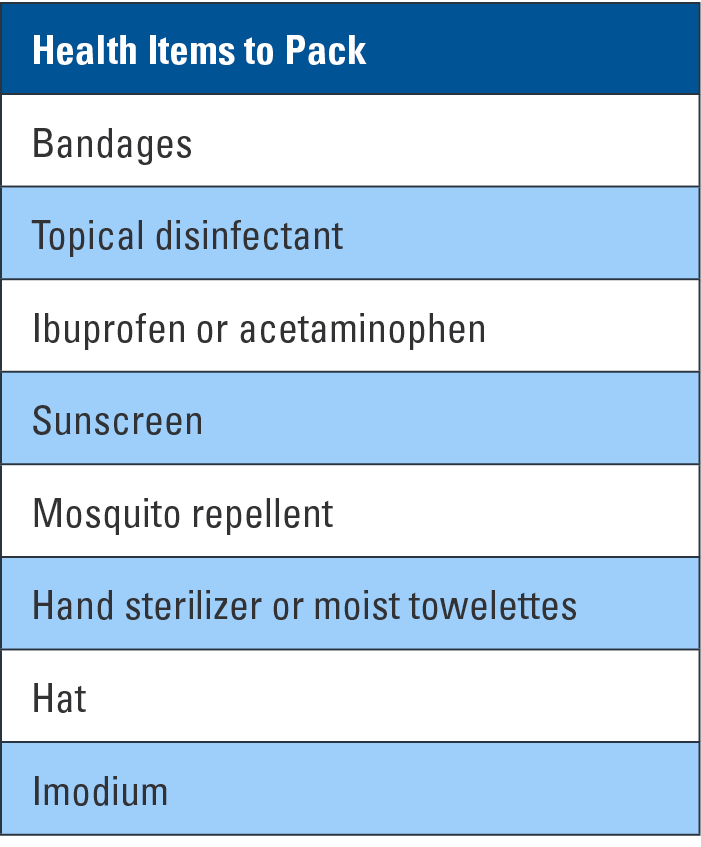
    Health Items Packing List

    Remember to pack first aid items such as bandages, topical disinfectant, an anti-inflammatory such as ibuprofen, sunscreen and mosquito repellent. See chart for a more complete list. Prescription medications should be in your carry-on in the original labeled containers. Bring enough for the days you will be away plus a few more days in case of unforeseen travel delays or dropped pills.

    Trips that cause immobility for prolonged periods regardless of mode of travel (plane, car, bus) increase the risk of blood clots in the legs. The World Health Organization estimates a doubling of risk in people who are continuously seated for four hours or more. The risk does not decrease back to baseline immediately after the flight, taking about 2 weeks to normalize, according to an article in the British Medical Journal (BMJ 2003; 327:1072). Maintaining hydration with non-caffeinated, non-alcoholic beverages and exercising calf muscles by flexing and extending at the ankles or walking about helps to decrease the risk. Compression stockings are also helpful.

  • Jet Lag and Travel Fatigue

    People often speak of having jet lag even on short trips. Jet lag usually occurs when traveling across five or more time zones. Recovery may take 3-5 days. It is due to the body’s natural clock (circadian rhythm) not being able to keep up with the change in time zones. Jet lag is characterized by insomnia and daytime sleepiness. Some people also experience dysphoria, decreased physical performance, difficulty with thinking or gastrointestinal disturbances.

    fatigued woman yawning

    Travel fatigue is different than jet lag as it occurs even on short trips. The fatigue comes from prolonged immobility, irregular sleep and eating patterns and dehydration. Travel fatigue and jet lag may both occur.

    Light is a key factor in maintaining our body clocks. The pineal gland, which is adjacent to the optic nerve in our brain, secretes melatonin which keeps the body in a regular rhythm. The ordinary circadian rhythm is approximately 25 hours. Since we use 24 hour clocks, the day/night cycle is entrained by light. Without light cues we would operate on a 25 hour schedule.

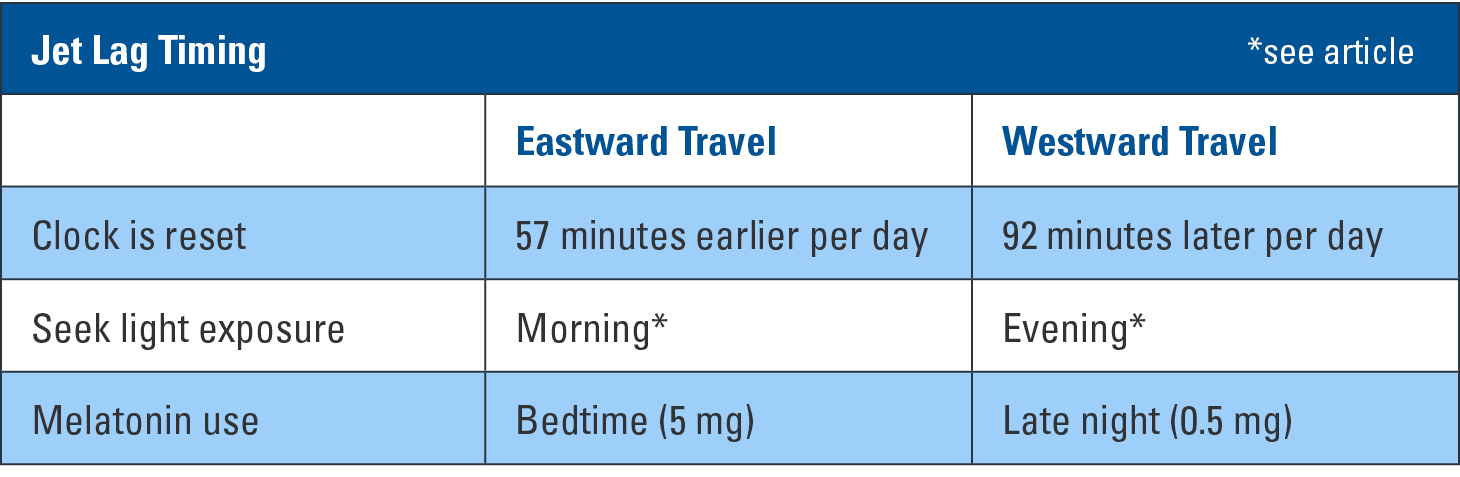
    Timing light exposure therefore helps to improve jet lag (see chart below). This with or without taking melatonin may decrease symptoms. Other options include ensuring optimal length and timing of sleep and sometimes prescription medications. Short daytime naps may be helpful, but care should be taken not to sleep for more than 30-60 minutes lest the insomnia will be worse.

    Jet Lag Timing chart

    Traveling east is harder on our system then traveling west. When going more than eight time zones it is helpful to get light exposure in the morning if traveling east and in the evening when traveling west. However, some experts recommend treating as if going westward when moving across more than eight time zones as the timing of light exposure may confuse the body between dawn and dusk. Westward travel causes the body clock to advance 92 minutes later each day while eastward travel moves the body clock 57 minutes earlier.


    “When going more than eight time zones it is helpful to get light exposure in the morning if traveling east and in the evening when traveling west.”


    The optimal dose of melatonin is uncertain, but some recommend taking 5 mg at bedtime if going east and 0.5 mg late at night if going west. Using prescription medication may help, but the risk is amnesia, confusion, hangover during the day, and increased risk of blood clots due to immobility. Caffeine may help with wakefulness, but it can also worsen insomnia at night. Some people promote eating a high protein diet for breakfast and a high carbohydrate diet for dinner to improve jet lag, but this is unproven. Promoting exercise for jet lag is also uncertain, but there is little potential for harm with this strategy.

    Jet lag and travel fatigue seem to be a small price to pay for the richness of experience traveling to new surroundings. These suggestions should help to maximize the experience.

  • In-Flight Travel Emergencies

    US passport image
    As you travel there is an occasional call for medical assistance overhead. This is a surprisingly rare event given the number of people that take airplane flights. There are 2.75 billion passengers globally each year. A study done at the University of Pittsburgh in 2010 evaluated the outcomes on commercial flights from 2008 to 2010. They found that 1 out of 604 (0.17%) flights had a medical emergency. Of these emergencies, almost a quarter (23%) occurred on the ground. In-flight emergencies rarely caused an early landing (7%).


    “The most common reasons to divert the aircraft were for emergencies related to heart issues, gynecological or obstetrical problems, possible stroke and seizures.”


    The most common reasons to divert the aircraft were for emergencies related to heart issues, gynecological or obstetrical problems, possible stroke and seizures. Passing out or nearly passing out was the most common cause to call for emergency medical help. A quarter of the patients were taken to the hospital and less than 10% were admitted. Fortunately death occurred only 0.3% of the time.

    Although medical emergencies do happen, airlines have procedures and emergency equipment available to deal with these rare occurrences.