Blog

  • Psychological Effects of Aging

    The effect of aging on emotional well-being is generally positive. Age brings acceptance which can be defined as the process of deliberately and non-judgmentally engaging negative emotions. Over time we have greater awareness and understanding. Acceptance does not depend upon mental capabilities or brain processing speed. Uncertainty, unpredictability and impermanence is better accepted with age. There is some evidence that today’s younger adults may not show increasing acceptance with age. 

    Another effect of age is decreasing anger. Sadness however is not reduced. One theory suggests that social connectedness is hindered by anger and anxiety, but helped by sadness. The difficulty with social connectedness as we age is fewer structured activities that promote connectedness.


    “Life satisfaction is a comparison of life circumstances to one’s internal expectations. Satisfaction is affected by age and gender. Younger people tend to be unrealistic about the future, while older people are more realistic about the past and the future.”


    Evidence for the effects of age on anger, sadness and anxiety comes from a study measuring these emotions. A survey was given to people ages 21–73 before and after exposure to a stressful situation. Daily reports were also collected for two weeks. People were shown an emotionally-neutral short film prior to getting baseline measures, then they were given two minutes to prepare a speech stating their qualifications for a new job while being videotaped. The study results confirmed decreased anxiety and anger, but not sadness.

    Life satisfaction is a comparison of life circumstances to one’s internal expectations. Satisfaction is affected by age and gender. Younger people tend to be unrealistic about the future, while older people are more realistic about the past and the future. Men most highly rate satisfaction on partnership and financial position while women rate on partnership, relationship with children, sexuality, work situation, contribution to others’ welfare and financial situation.

    One survey of people ages 30–74 rated life satisfaction on health, financials, work, contribution to others’ welfare, relationship with children, partnership relations, and sexuality now, ten years ago and ten years from now. In all cohorts life was rated better now than in the past on all measures except for health and sex. People report health was worse than in the past and did not expect improvement, while sex was worse than in the past but expected to improve. The oldest cohorts were more satisfied with their partners than the youngest group.
  • Antibiotic Resistance Threats

    Antibiotic resistance is defined as a bacteria which is resistant to one or more antibiotics used to treat it. While it is a growing problem, steps can be taken to minimize the spread. The first identification of penicillin antibiotic resistance was in 1940, even before the first use of penicillin in 1943. Although this is an old problem, the Centers for Disease control came out with their first comprehensive report on the topic in 2013. Annually, at least two million people in the United States get antibiotic-resistant infections and 23,000 people die. The estimated treatment cost is $20 billion and lost productivity is $35 billion in 2008 dollars.

    Besides human use, animal use for food production also causes antibiotic resistance. More antibiotics are used in food production than for human use, but we will not address that here other than to report that the FDA has issued guidance regarding animal use.

    The CDC report categorized threats as urgent, serious or concerning. Threats were categorized by expert opinion based on clinical and economic impact, incidence, 10-year projected incidence, transmissibility, availability of effective antibiotics and barriers to prevention.


    “The best known methods to prevent antibiotic resistance is to prevent infections through hand washing, safe food preparation and vaccination, when available.”


    Clostridium dificile is one bacteria listed as an urgent threat — it causes watery diarrhea. People are infected when they take antibiotics that change the natural flora of the gut, allowing bacteria to flourish and secrete toxins into the gut. Although resistance is not significant at this time, it was listed as an urgent threat due to its relation to antibiotic use in general. Clostridium causes at least 250,000 illnesses and 14,000 people die from it each year. As with many infections, older, immunocompromised patients are more susceptible.

    Methicillin-resistant staphylococcus aureus (MRSA) is listed as a serious, not-urgent threat despite the widespread news coverage. This is due to decreasing number of infections and newer effective antibiotics.

    The best known methods to prevent antibiotic resistance is to prevent infections through hand washing, safe food preparation and vaccination, when available. Additionally, the CDC tracks resistant bacteria in order to prevent spread. Improving use of antibiotics only for appropriate indications and developing new antibiotics and tests for resistant bacteria will also help fight resistance. Even when antibiotics are used for the proper indications, resistance is increased. Thus reducing overall use will decrease the speed of developing resistance.

  • Evaluating Lab Tests and Clinical Studies

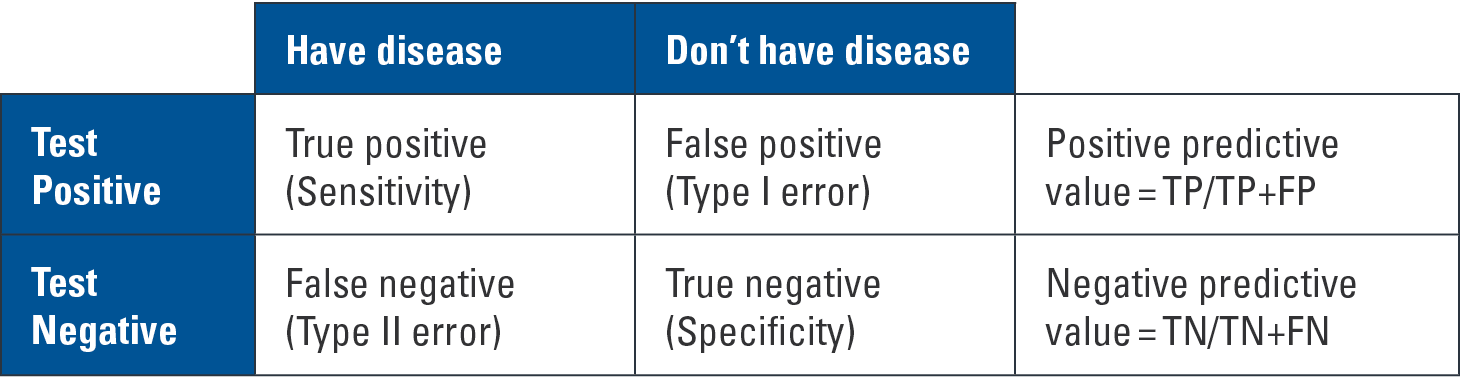
    Ever wonder how lab tests and clinical studies are judged on usefulness? Clinical trials are performed to statistically assess performance of tests and treatments. Measures are reported on sensitivity, specificity, positive predicative value, negative predictive value or likelihood ratios (see table, below). Likelihood ratios (LR) use the sensitivity and specificity to determine how likely a test will rule in or rule out a disease. The ratios can be reported as positive or negative. Positive ratios over 10 are excellent, and between 5.1 and 10 are good. Negative ratios less than 0.1 are excellent and between 0.19 and 0.1 are good. Sensitivity, specificity and LR can be calculated without knowing the disease prevalence. Positive predictive value and negative predictive values can be calculated if the disease prevalence is known. The positive predictive value is the number of true positives/true positives + false positives. The negative predictive value is the number of true negatives/true negatives + false negatives.


    “In addition to the numbers, there are many other variables that must be known in order to evaluate any test or clinical study.”


    To illustrate, HIV tests are now available over the counter for testing from an oral swab. One of these tests has a sensitivity of 99.3% and specificity of 99.9%. There are approximately 900,000 people in the U.S. with HIV out of 313 million people. That is a prevalence rate of 0.29%. Using these numbers and the math as outlined above, there is a positive LR of 993 and a negative LR of 0.007. According to the LR the test is very good. The test can also be evaluated using positive and negative predictive values. Again, using these numbers the positive predictive value is 75% while the negative predictive value is 99%. Therefore the oral swab test for HIV is much better at ruling out the disease than proving the disease is present. That is why a positive test must be followed up with more definitive testing. Even though the sensitivity and specificity of the test was over 99%, because the prevalence of the disease is so low, the test is limited at positively predicting the disease.

    These computations show that it is very difficult to fully appreciate the true meaning of test results based on news reports. In addition to the numbers, there are many other variables that must be known in order to evaluate any test or clinical study.

  • Blood Safety

    The World Health Organization (WHO) recommends that countries have a national blood system governed by a national blood policy. In 2013, 79% of high-income countries — including the United States — followed this recommendation. The United States keeps its blood supply safe by a number of mechanisms. Blood donors are screened, blood is quarantined and tested, and donors are disqualified from donating to ensure safety. Blood can come from voluntary, unpaid donors, family or replacement donors or paid donors. In the U.S., only voluntary, unpaid donors, family donors or replacement donors are acceptable. Voluntary, unpaid donors are the safest subset from which to receive blood donations.

    Donors are screened for potential infectious diseases by answering multiple questions. Questions cover topics related to travel, behaviors, personal history of transfusions or cancers, and receipt of tissue grafts, to name a few. Acceptable responses are updated as new information is learned. For example, living in the United Kingdom or certain other European countries precludes donation due to risk of Creutzfeldt-Jacob disease (so-called “mad cow disease”). Those who have traveled to certain countries or areas of countries may also be excluded from donating for a limited time. Anyone incarcerated for more than three days is deferred from donating for 12 months after release. Those who have engaged in illicit intravenous drug use are prevented from donating during their lifetime. Anyone who’s had tattoos applied in a regulated state (Illinois included) with sterile needles and non-reusable ink is eligible to donate.


    “The United States keeps its blood supply safe by a number of mechanisms. Blood donors are screened, blood is quarantined and tested, and donors are disqualified from donating to ensure safety.”


    All donations are screened for hepatitis B and C, HIV, syphilis, HTLV I and II, West Nile virus and Chagas disease. Until the tests are complete and negative, the blood is quarantined from being used in transfusions. If a donor is deferred for any reason, they are placed on a list and no donations are accepted from that individual. According to the WHO, in high-income countries, the median risk of infection from donations is 0.003% for HIV, 0.03% for hepatitis B, 0.02% for hepatitis C and 0.05% for syphilis.

    Transfusion practices also contribute to safety. Limiting unnecessary transfusions lessens risk to patients. In the U.S., transfusion of red blood cells is generally not recommended unless the patient’s hemoglobin is less than 7 (normal is over 13.5 for women and 14.5 for men). Transfusion of platelets is only recommended for counts under 10,000 except in cases of active bleeding or essential surgery and procedures. Blood is typed and matched for both major (A, B, O) and minor compatibility. This matching is only considered valid for 72 hours and then must be repeated if more transfusions are needed. At the time of transfusion, both the blood product and patient are cross-verified by two healthcare professionals prior to initiating the transfusion.

    No one wants to receive a transfusion, but be assured that multiple layers are in place on both the donation and transfusion sides to ensure the safest possible procedure for patients.

  • What is the Best Way to Dispose of Unwanted Medication?

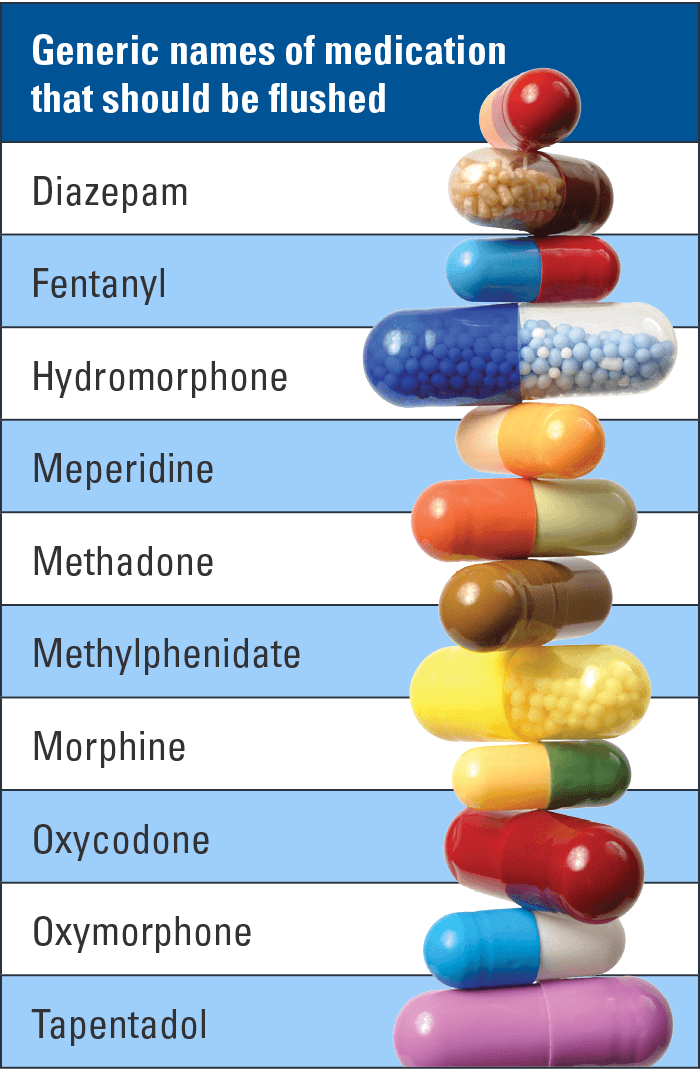
    Generic names of medication that should be flushed: Diazepam; Fentanyl; Hydromorphone; Meperidine; Methadone; Methylphenidate; Morphine; Oxycodone; Oxymorphone; Tapentadol;

    In this age of green living, one often wonders how to responsibly dispose of medications. Although there is concern that medications flushed down the toilet contribute to water pollution, it turns out that much more medication reaches the water supply after ingestion into the human body and excretion as waste. Therefore, the best way to limit waste is to live healthy, thereby limiting the need for medications. When medications are needed one should use care not to overstock. If your medication expires, some are best flushed while others should be put in the trash. The FDA recommends flushing controlled substances down the toilet (see list). Beware that patches still contain significant amounts of active medication that can be harmful if applied or ingested by children or animals.


    “When medications are needed one should use care not to overstock. If your medication expires, some are best flushed while others should be put in the trash.”


    Other medications should be removed from containers, mixed with coffee grounds or kitty litter and sealed in a plastic bag before placing them in the garbage. This makes it unpalatable for the meds to be recovered and then ingested. The empty bottle should have personal identifying information scratched off prior to disposal or recycling. 

    Alternatively, some pharmacies will take back medications. See DisposeMyMeds.org for a store locater. The FDA also has take back days. These events can be found here.

  • Testosterone

    Happy, laughing Mature African American Male

    Advertisements for “low T” are everywhere now. The term is ubiquitous and even shows up in medical journals. Hypogonadism can be defined as symptoms of testosterone deficiency, along with levels two standard deviations below levels in young healthy men. Symptoms associated with hypogonadism may include decreased libido, loss of secondary sex characteristics, fatigue and depressed mood. Decreasing testosterone naturally occurs with age as 20% of men older than 60 and 50% of men older than 80 years have levels in hypogonadal range. Prevalence has been estimated at 5.6% between the ages of 30 and 79.

    Testosterone supplementation has become easier as transdermal applications are now available instead of injections. As a result of this delivery method and advertising about decreased sexual function, use of testosterone has dramatically increased. Prescriptions have increased 500% between 2000 and 2011 to 5.3 million prescriptions, and costs $1.6 billion. The number of patients being treated increased from 1.3 to 2.3 million during 2010–2013. Most prescriptions for testosterone (60%) are prescribed by primary care providers. Review of claims data in 250,000 men revealed that only 72% of men given testosterone prescriptions had a level checked prior to initiating therapy, 21% never had a level checked and 6% were checked after receiving a prescription for testosterone.


    Decreasing testosterone naturally occurs with age as 20% of men older than 60 and 50% of men older than 80 years have levels in hypogonadal range.


    As one would expect, testosterone affects body composition, strength and sexual function. One study examined testosterone and estradiol on these functional components. Testosterone production was blocked and then either replaced or given placebo. Another set of patients in the study also received medication to block testosterone conversion to estradiol, which normally happens in the body. The authors found that decreases in either testosterone or estradiol reduced sexual function. Testosterone deficiency accounted for decreased muscle mass, lean mass and strength, while estradiol deficiency accounted for an increase in body fat. The amount of testosterone needed to maintain muscle mass and strength varied greatly among individuals but was dose-related. Decreased muscle mass and strength are predictors of falls, fractures and ability to live independently. However, there is no evidence that testosterone supplementation reverses these risks. Cognition is also not improved with testosterone replacement.

    Increased risk of cardiovascular disease is caused by testosterone replacement. A retrospective Veterans Administration study evaluated testosterone use, heart attack, stroke and death. Veterans with low testosterone levels who had coronary angiograms between 2005–2011 were followed and stratified based on testosterone replacement. Of the 8,709 men who qualified for the study, 1,223 started on testosterone. Almost 20% of men who did not have testosterone replacement had an event, compared with 25.7% who did have testosterone.


    For a select group of men the benefits outweigh the risks, however, based on the number of prescriptions it is unlikely that the general population is educated about testosterone replacement.


    Other side effects of therapy can include acne, breast swelling or tenderness, increased red blood cell count, swelling of the feet or ankles, reduced testicular size and infertility. The effect of testosterone on prostate cancer is controversial.

    The decision to start testosterone replacement is personal. For a select group of men the benefits outweigh the risks, however, based on the number of prescriptions it is unlikely that the general population is educated about testosterone replacement. Prior to any treatment, it is imperative to prove that testosterone levels are low.