Blog

  • Physical Activity Recommendations

    The amount of physical activity recommended for adults is 150 minutes of moderate activity per week, along with muscle-strengthening activity of all muscle groups twice a week. Alternatively, one may get 75 minutes of vigorous activity a week with muscle strengthening twice a week. A mixture of moderate and vigorous activity is also acceptable. Doing ten minutes of activity at a time still counts toward the weekly total. Only 54% of people in Illinois get the recommended amount of physical activity while 24% do not get any leisure-time activity, based on data from 2013.

    So what is moderate and vigorous activity? Activity levels can be roughly assessed using breathing and heart rate. With moderate activity, one can talk in sentences, while with vigorous activity one can only say a few words before needing to take a breath. Using heart rate as a guide, moderate activity is when the heart rate reaches 50–70% of maximum for one’s age, and 70–85% is considered vigorous activity. Maximum heart rate is computed as 220 minus age. Increasing heart rate to the maximum and beyond is not necessary.

    Activities that are considered moderate intensity include walking between 3–4.5 mph, hiking, biking 5–9 mph, yoga and dancing, to name a few. Housework, including scrubbing the floor or bathtub on hands and knees, washing windows and sweeping also are moderately-vigorous activities. Vigorous activity examples include walking, jogging or running more than 5 mph, biking over 10 mph, competitive ballroom dancing and other competitive sports. Household vigorous activity includes moving heavy furniture, carrying 50 pounds or more and shoveling more than 10 pounds a minute. A more extensive list of activities can be found here.

  • Effect of Exercise on Mortality

    Woman doing plank

    Since 2008 the U.S. government has issued activity guidelines. The recommendations are reported in this article. Of the 150 minutes weekly of moderate-intensity activity, vigorous activity can be substituted with a 1:2 ratio of minutes needed. However, cardiorespiratory and metabolic fitness is a better indicator of morbidity and mortality than the amount of time of activity. So despite the recommendations, which are for a minimum amount of activity, is there benefit to more vigorous activity?

    One study evaluated the proportion of moderate or vigorous activity that was accounted for by vigorous activity and whether more vigorous activity decreased mortality. Studies have also examined if there is an upper threshold of vigorous activity that exists such that mortality is not improved or worsened.


    “Based on these two analysis, increasing activity prolongs longevity and, up to a point, increasing vigorous activity is more beneficial than moderate activity. “


    The study was performed on 204,000 people in Australia between the ages 45 and 75. This is 10% of the entire population in New South Whales. Self-reported activity intensity is a better predictor of mortality than total amount of activity so self-reported activity data was assessed using a questionnaire. Vigorous activity was defined as “activity that made you breathe harder or puff and pant, like jogging, cycling, aerobics, competitive tennis, but not household chores or gardening.” Moderate activity examples were “gentle swimming, social tennis, vigorous gardening or work around the house.”

    The questionnaire collected data on minutes of walking and minutes of moderate-vigorous physical activity. Covariate analysis with age, sex, education, marital status, urban/rural, BMI, smoking, physical function, alcohol, fruit and vegetable consumption, and total MVPA was also done. The sample was heterogeneous with 64% obese and 55% without any vigorous activity. Sixteen percent of respondents had between 0 and 30% of total activity time being vigorous, and 28% had 30% or more of their activity being vigorous.

    Results are shown in the table below. Increasing amount of time of activity decreases mortality and any report of physical activity decreased mortality 9–13%. This protective effect of activity carried across all subgroups including those with and without cardio-metabolic disease. Another meta-analysis showed that walking pace, not time spent walking, is associated with longevity.
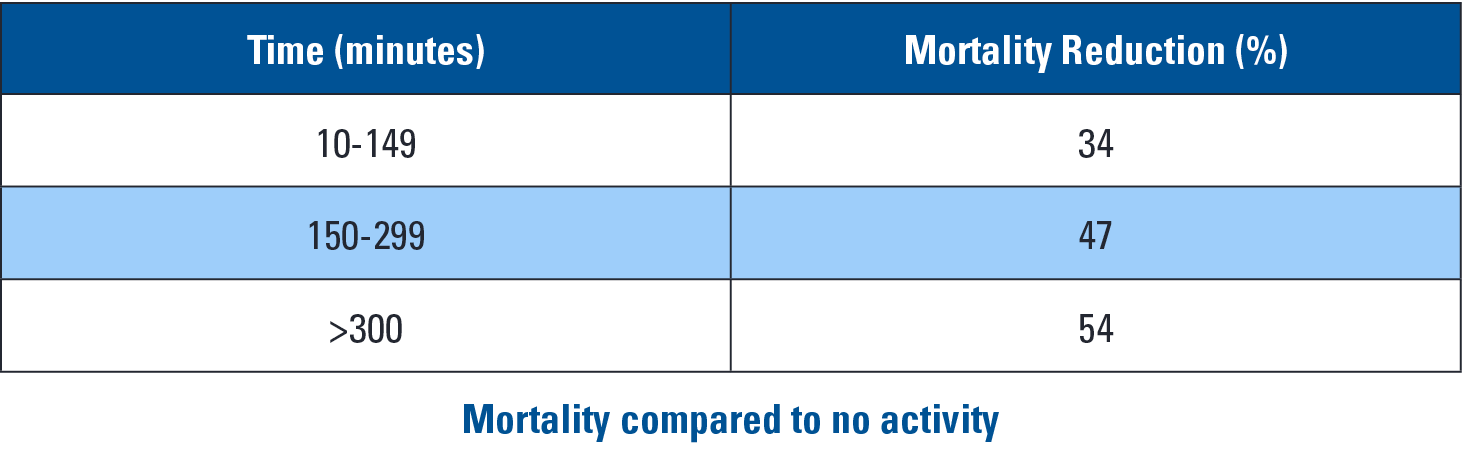
    Effect of Exercise on Mortality — Mortality compared to no activity

    There are a lot of people in the United States doing highly intense physical activity. In 2013, 541,000 people completed a marathon and in 2012 there were 510,000 USA triathalon members. Additionally, there are a lot of people doing high-intensity interval training. If increased intensity activity is beneficial, then is there an upper limit to the amount of vigorous activity, at which point it becomes detrimental?

    An evaluation was done using pooled analysis of 6 cohorts in the National Cancer Institute Cohort Consortium analysis of BMI, physical activity and mortality. Estimated leisure time physical activity (LTPA) based on METs and hours per week of exercise were reported. This was analyzed accounting for covariates of age, sex, race/ethnicity, education, smoking, cancer history, heart disease history, alcohol and marital status. The sample consisted of 661,000 people with median follow up over 14 years. Median age at entry was 62, median leisure-time physical activity (LTPA) was 8 MET hours/week (150 minutes is 7.5 MET hours/week).

    The study showed younger, married, non-smokers, with lower BMI and fewer comorbidities exercised the most. Again, compared to no activity, any level of activity decreased mortality. In subgroup analysis, any level of vigorous activity decreased mortality by 20%, even if less than the recommended amount. The table below shows the decrease in mortality compared with activity level. Cardiovascular death was minimized at 3–5 times the recommended amount of activity and increased again at 10 or more times over the minimum. However, those doing 10 or more times over the minimum recommendation had a 31% lower risk of cancer death.

    Based on these two analysis, increasing activity prolongs longevity and, up to a point, increasing vigorous activity is more beneficial than moderate activity. Although these studies included people with cardiovascular disease, we do not know the severity of this or other illnesses. The results may not be generalizable to people with more severe illness, but the overall recommendation that increasing activity is beneficial seems to make sense for everyone, regardless of overall health.
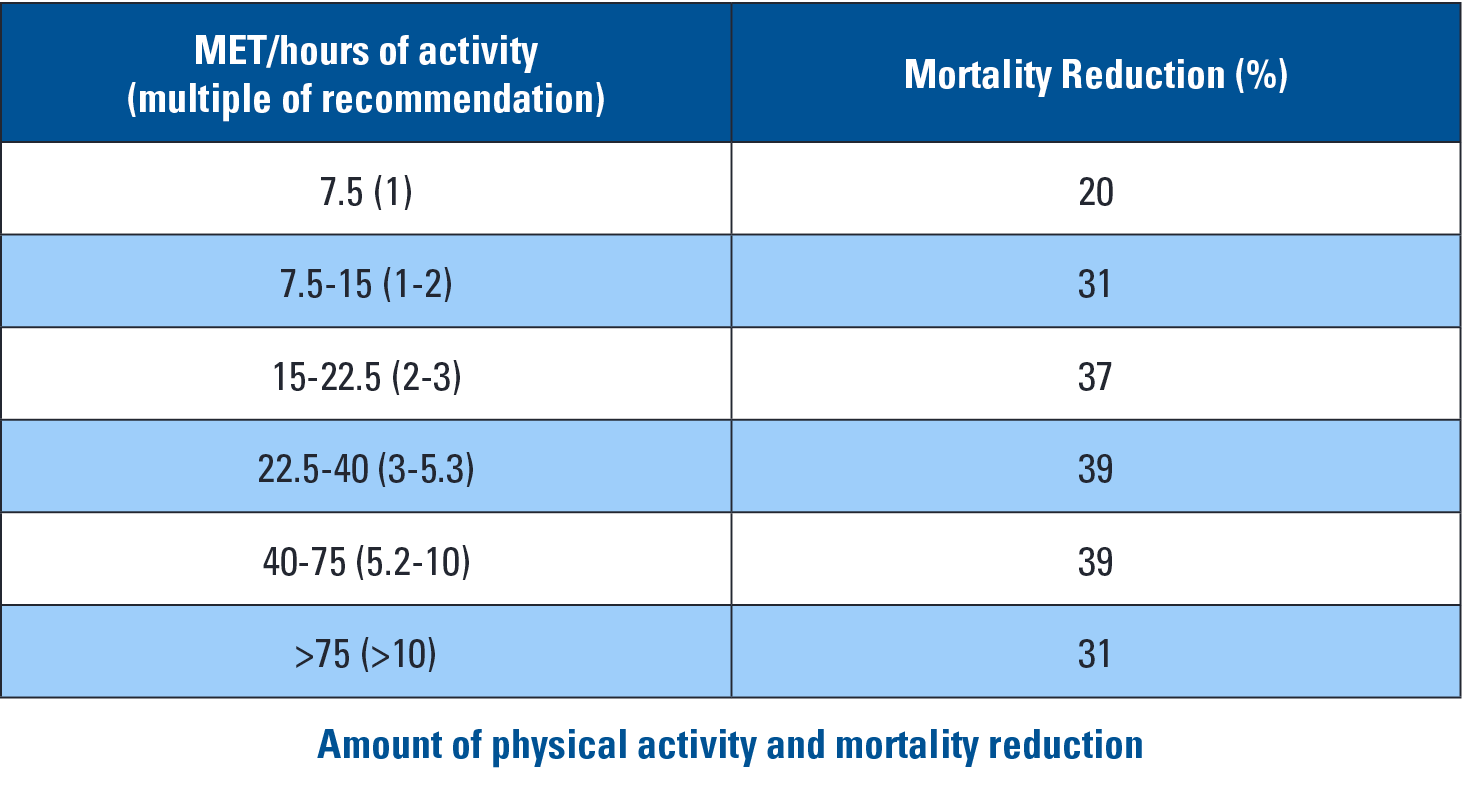
    Effect of Exercise on Mortality — Amount of physical activity and mortality reduction

  • Activity Monitor Accuracy

    Man with Activity Monitor

    It seems that everyone knows someone who is using an activity monitor these days. They come under a variety of brands including Fitbit, NikeFuel, Jawbone Up and others. Some report steps taken while others are more sophisticated and also report energy expenditure. Accuracy varies among devices and should only be used as a guide.

    The most common way to measure steps is with accelerometry. The device measures change in speed to estimate the number of steps. One study took 16 healthy volunteers and measured activity recorded on various monitors while lying, sitting, standing, walking or shuffling. Error rates were between 4.5–17.2% when compared with manually counted videotaped steps. Error was speed dependent with slow speed having worse accuracy. NikeFuel band underestimated while Jawbone Up overestimated the number of steps at slow speed. Accurately counting steps on stairs was especially difficult for the monitors.


    “Although these devices are not precise, they provide a reasonable estimate of activity.”


    Energy expenditure reporting is accomplished by converting activity data via an algorithm into energy consumption. This can be done with or without the aid of heart rate, temperature, heat flux or galvanic skin heat response. Monitors were tested in one study using 60 healthy volunteers. Resting energy expenditure was measured and the following week subjects were fitted with multiple monitors. They did activities including being sedentary, walking on a treadmill, jogging/running on a treadmill, and moderate to vigorous activities for 3–5 minutes during measurement. Energy expenditure over the entire duration was examined. Energy consumption estimates were be off by 9–23.5%. Fitbit error was approximately 10%, Jawbone approximately 12%, Nike Fuel 14% and Basis Band 23.5%. However, the standard error of the error measurements was between 6–17% in the study.

    Another study examined shoe-based monitors. These sensed acceleration and foot pressure. Subjects walked in a calorimetric room that measures oxygen and carbon dioxide levels, which is a very accurate way to determine energy expenditure. The shoe-based monitors were accurate within 6% of energy expenditure while commercial monitors such as the Fitbit and DirectLife were off by approximately 14–18%.

    Although these devices are not precise, they provide a reasonable estimate of activity. Effectiveness of the devices to motivate increased activity is an area that is being intensely studied. In the meantime, go ahead and use it if you have one.

  • The 2015 Updated Beers Criteria for Potentially Inappropriate Medication Use in Older Adults

    By the American Geriatrics Society 2015 Beers Criteria Update Expert Panel


    For more than 20 years, the Beers Criteria for Potentially Inappropriate Medication Use in Older Adults has been the leading source of information about the safety of prescribing drugs for older people. To help prevent medication side effects and other drug-related problems in older adults, the American Geriatrics Society (AGS) has updated and expanded this important resource. The expanded AGS Updated Beers Criteria for Potentially Inappropriate Medication Use in Older Adults identifies medications with risks that may be greater than their benefits for people 65 and older.

    Why Experts Developed the Beers Criteria

    As you get older, your body changes. These changes can increase the chances that you’ll have side effects when you take medications. Older people usually have more health problems and take more medications than younger people. Because of this, they are also more likely to experience dangerous drug-drug interactions. Every year, one in three adults 65 or older has one or more adverse (harmful) reactions to a medication or medications. This is why it’s important for researchers to identify and help reduce use of drugs that are associated with more risks than benefits in older people.

    Download the AGS Updated Beers Criteria for Potentially Inappropriate Medication Use in Older Adults |

  • Trip Preparation

    Trip planning is exciting, but also entails a lot of work. If traveling out of the country it is prudent to review health needs a few months in advance. Travel to developed countries generally does not necessitate vaccinations ahead of time. Developing and third-world trips, however, may require a number of vaccinations prior to leaving to protect against disease transmission from various sources including mosquitos, animals, and food or waterborne illness. The need for vaccination may also depend on the duration of the trip and activities planned.


    “Whether at home or traveling, keeping a list of prescription medications and dosages in your purse or wallet is always a good idea.”


    Some possible vaccinations include hepatitis A, hepatitis B, malaria prophylaxis, and yellow fever. Planning for these should be done at least a month before departure. Routine immunizations should also be reviewed such as influenza, pneumonia and diphtheria-tetanus-pertussis. Sources to check regarding immunization need include the travel agent or tour group, the Center for Disease Control website, and of course, your physician. Treatment can be done in the office or, depending upon the vaccination, a travel clinic. If traveling to areas with high risk of bacterial associated traveler’s diarrhea discuss bringing an antibiotic with your doctor. Whether at home or traveling, keeping a list of prescription medications and dosages in your purse or wallet is always a good idea.

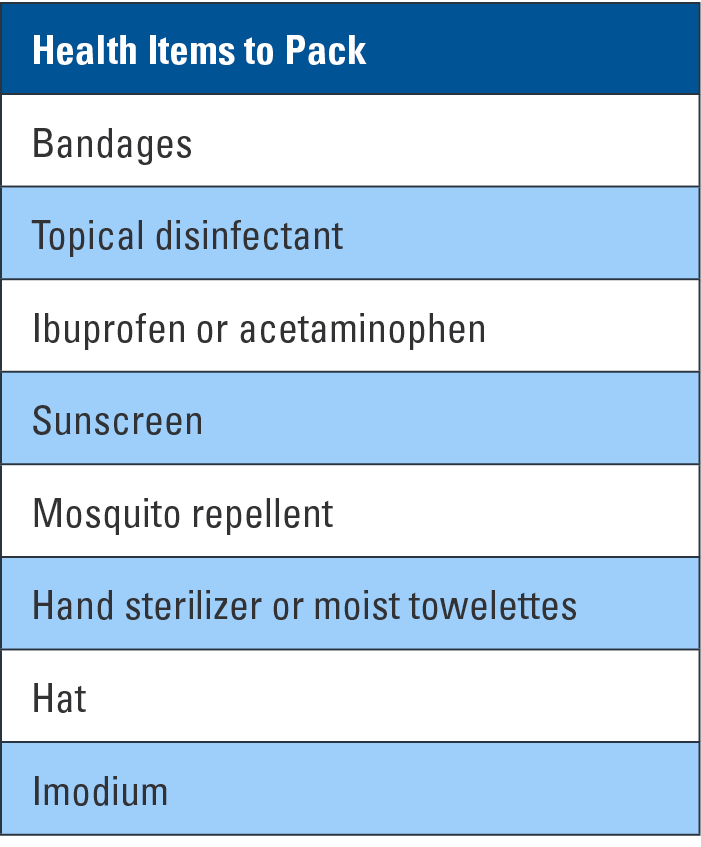
    Health Items Packing List

    Remember to pack first aid items such as bandages, topical disinfectant, an anti-inflammatory such as ibuprofen, sunscreen and mosquito repellent. See chart for a more complete list. Prescription medications should be in your carry-on in the original labeled containers. Bring enough for the days you will be away plus a few more days in case of unforeseen travel delays or dropped pills.

    Trips that cause immobility for prolonged periods regardless of mode of travel (plane, car, bus) increase the risk of blood clots in the legs. The World Health Organization estimates a doubling of risk in people who are continuously seated for four hours or more. The risk does not decrease back to baseline immediately after the flight, taking about 2 weeks to normalize, according to an article in the British Medical Journal (BMJ 2003; 327:1072). Maintaining hydration with non-caffeinated, non-alcoholic beverages and exercising calf muscles by flexing and extending at the ankles or walking about helps to decrease the risk. Compression stockings are also helpful.

  • Jet Lag and Travel Fatigue

    People often speak of having jet lag even on short trips. Jet lag usually occurs when traveling across five or more time zones. Recovery may take 3-5 days. It is due to the body’s natural clock (circadian rhythm) not being able to keep up with the change in time zones. Jet lag is characterized by insomnia and daytime sleepiness. Some people also experience dysphoria, decreased physical performance, difficulty with thinking or gastrointestinal disturbances.

    fatigued woman yawning

    Travel fatigue is different than jet lag as it occurs even on short trips. The fatigue comes from prolonged immobility, irregular sleep and eating patterns and dehydration. Travel fatigue and jet lag may both occur.

    Light is a key factor in maintaining our body clocks. The pineal gland, which is adjacent to the optic nerve in our brain, secretes melatonin which keeps the body in a regular rhythm. The ordinary circadian rhythm is approximately 25 hours. Since we use 24 hour clocks, the day/night cycle is entrained by light. Without light cues we would operate on a 25 hour schedule.

    Timing light exposure therefore helps to improve jet lag (see chart below). This with or without taking melatonin may decrease symptoms. Other options include ensuring optimal length and timing of sleep and sometimes prescription medications. Short daytime naps may be helpful, but care should be taken not to sleep for more than 30-60 minutes lest the insomnia will be worse.

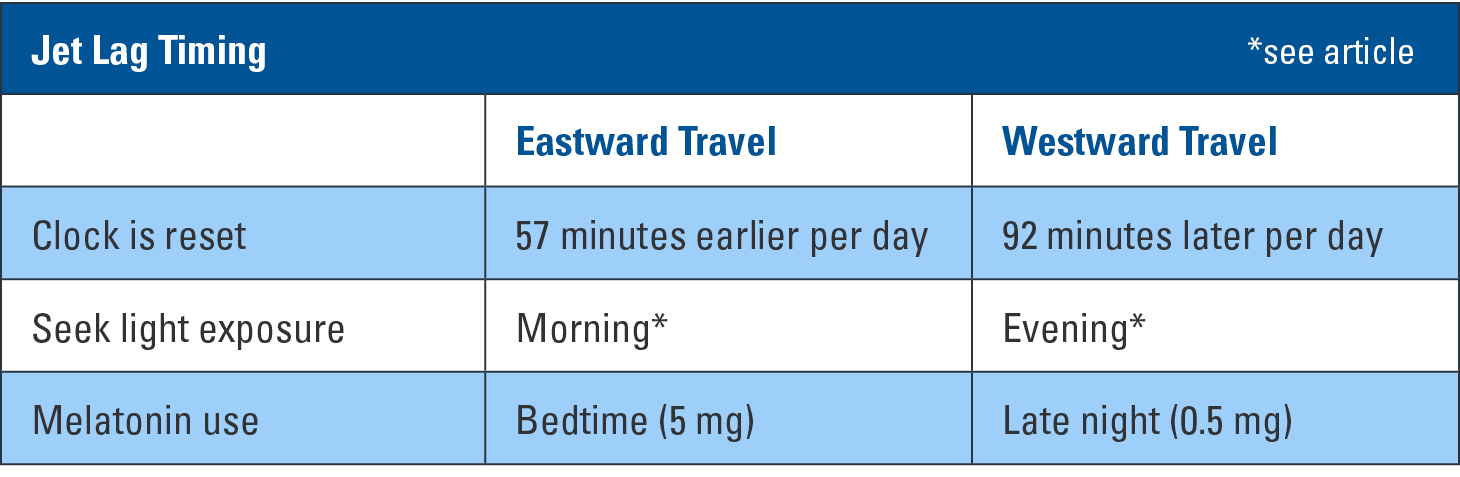
    Jet Lag Timing chart

    Traveling east is harder on our system then traveling west. When going more than eight time zones it is helpful to get light exposure in the morning if traveling east and in the evening when traveling west. However, some experts recommend treating as if going westward when moving across more than eight time zones as the timing of light exposure may confuse the body between dawn and dusk. Westward travel causes the body clock to advance 92 minutes later each day while eastward travel moves the body clock 57 minutes earlier.


    “When going more than eight time zones it is helpful to get light exposure in the morning if traveling east and in the evening when traveling west.”


    The optimal dose of melatonin is uncertain, but some recommend taking 5 mg at bedtime if going east and 0.5 mg late at night if going west. Using prescription medication may help, but the risk is amnesia, confusion, hangover during the day, and increased risk of blood clots due to immobility. Caffeine may help with wakefulness, but it can also worsen insomnia at night. Some people promote eating a high protein diet for breakfast and a high carbohydrate diet for dinner to improve jet lag, but this is unproven. Promoting exercise for jet lag is also uncertain, but there is little potential for harm with this strategy.

    Jet lag and travel fatigue seem to be a small price to pay for the richness of experience traveling to new surroundings. These suggestions should help to maximize the experience.